
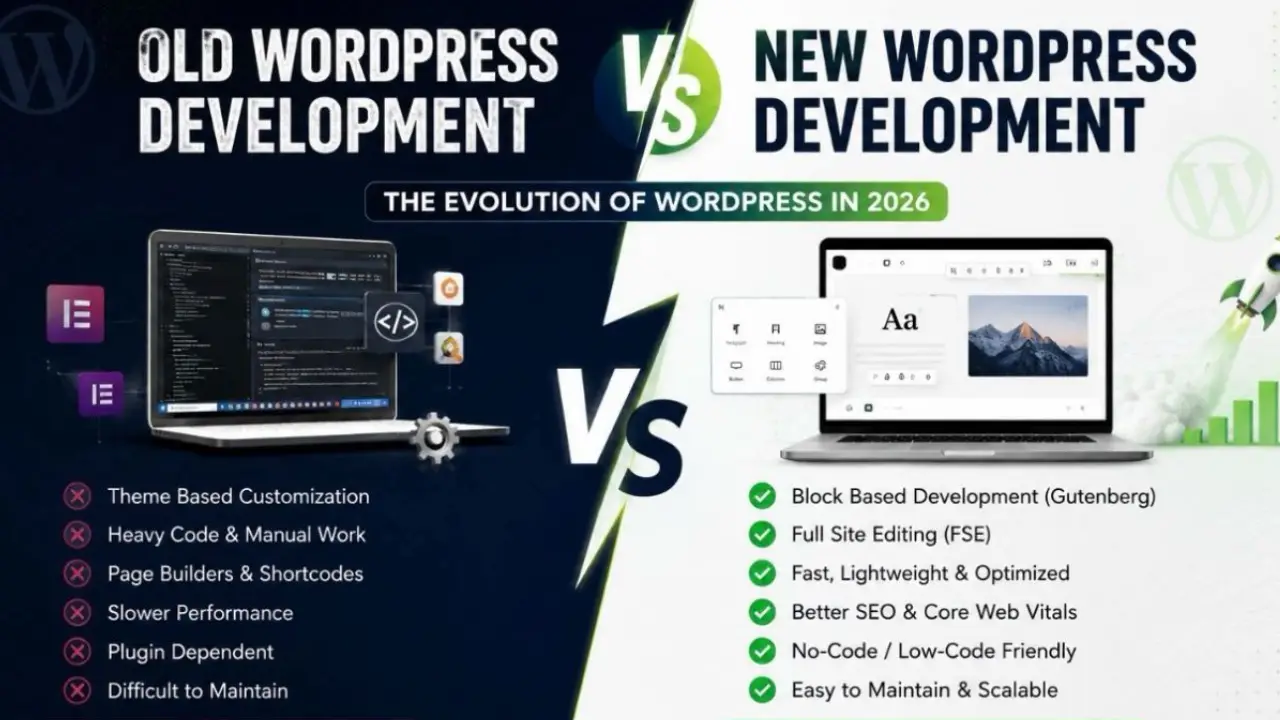
The Evolution of WordPress Development
WordPress has evolved dramatically over the last few years. What once required extensive coding, complex theme customization, and heavy plugin dependency has transformed into a faster, more flexible, and user-friendly development experience.
With the rise of Gutenberg, Full Site Editing (FSE), and modern performance-focused practices, WordPress development in 2026 is very different from traditional WordPress development.
In this article, we’ll compare the old and new approaches to WordPress development and explore why modern WordPress is becoming the preferred choice for businesses, developers, and website owners.
Old WordPress Development: Challenges and Limitations
Traditional WordPress development relied heavily on custom themes, page builders, and manual coding.
Key Characteristics
1. Theme-Based Customization
Developers often had to customize PHP templates, CSS files, and theme functions to make design changes.
Challenges:
- Time-consuming modifications
- Theme lock-in issues
- Difficult upgrades
2. Heavy Coding Requirements
Building custom layouts and features required extensive knowledge of:
- PHP
- HTML
- CSS
- JavaScript
Even small design changes often required developer intervention.
3. Dependence on Page Builders and Shortcodes
Many websites relied on:
- Elementor
- WPBakery
- Divi
- Custom shortcodes
While powerful, these tools sometimes increased page size and reduced performance.
4. Slower Performance
Older WordPress sites often suffered from:
- Excessive plugins
- Large CSS and JS files
- Render-blocking resources
This negatively impacted user experience and SEO rankings.
5. Maintenance Complexity
Managing updates, plugin conflicts, and theme compatibility required ongoing technical support.
Result:
1 Complex
2 Slow
3 Limited Scalability
New WordPress Development (2026): Smarter and Faster
Modern WordPress development focuses on performance, flexibility, and user experience.
Key Innovations
1. Block-Based Development (Gutenberg)
The Gutenberg editor has transformed content creation.
Benefits include:
- Visual editing experience
- Reusable blocks
- Better content management
- Cleaner code structure
Users can now build sophisticated layouts without relying heavily on third-party page builders.
2. Full Site Editing (FSE)
Full Site Editing allows users to customize:
- Headers
- Footers
- Templates
- Navigation menus
- Global styles
All without editing theme files.
3. Faster and Lightweight Websites
Modern themes are built with performance in mind.
Benefits:
- Smaller CSS files
- Reduced JavaScript
- Better loading speed
- Improved user experience
Popular lightweight themes include:
- GeneratePress
- Blocksy
- Kadence
- Twenty Twenty-Six
4. Better SEO and Core Web Vitals
Google increasingly rewards fast and optimized websites.
Modern WordPress development helps improve:
- Largest Contentful Paint (LCP)
- Cumulative Layout Shift (CLS)
- First Input Delay (FID)
This can lead to:
- Higher search rankings
- Better organic traffic
- Improved conversion rates
5. No-Code and Low-Code Friendly
Website owners can now:
- Create landing pages
- Design layouts
- Manage content
- Customize templates
without writing complex code.
Developers can focus on building advanced functionality rather than basic page layouts.
6. Easier Maintenance and Scalability
Modern WordPress architecture provides:
- Cleaner workflows
- Better compatibility
- Easier updates
- Long-term scalability
Comparison Table
| Feature | Old WordPress Development | New WordPress Development |
|---|---|---|
| Website Building | Theme Based | Block Based |
| Editing Experience | Limited | Visual Editing |
| Performance | Slower | Faster |
| SEO | Basic Optimization | Core Web Vitals Focused |
| Maintenance | Complex | Easier |
| Scalability | Limited | High |
| Coding Requirement | High | Low to Moderate |
| Flexibility | Restricted | Highly Flexible |
Why Businesses Should Adopt Modern WordPress
Businesses that embrace modern WordPress development can benefit from:
Faster Websites
Improved loading speeds lead to better user engagement and conversions.
Better Search Rankings
Performance optimization directly impacts SEO success.
Reduced Development Costs
Block-based tools reduce the need for constant developer involvement.
Easier Content Management
Marketing teams can update content without technical assistance.
Future-Proof Technology
WordPress continues to invest heavily in Gutenberg and Full Site Editing, making block-based development the future of the platform.
Is Traditional WordPress Development Dead?
Not entirely.
Custom PHP development, plugins, APIs, and advanced integrations still require experienced developers. However, the way developers build websites is changing.
Today’s WordPress developers are expected to understand:
- Gutenberg Block Development
- Full Site Editing (FSE)
- React for WordPress
- Performance Optimization
- SEO Best Practices
- Headless WordPress Architecture
- API Integrations
The future is not less development—it is smarter development.
Final Thoughts
The evolution of WordPress in 2026 shows a clear shift toward faster, lighter, and more scalable website development. While traditional methods relied heavily on custom themes, shortcodes, and extensive coding, modern WordPress embraces block-based development, Full Site Editing, and performance-first practices.
Whether you’re a business owner, blogger, or developer, adopting modern WordPress development can help you build better websites, improve SEO performance, and reduce maintenance overhead.
Key Takeaway:
The old way was complicated. The new way is smarter. Build better, rank higher, and grow faster with modern WordPress development.